
A beautiful website can make a great first impression. But good web design goes much further than attractive colors, impressive images, and modern typography.
Your website is one of the most important digital touch points between your business and your potential customers. It should not only look professional—it should communicate your message clearly, guide visitors naturally, work smoothly on different devices, and make it easy for people to take the next step.
The best websites combine design, usability, performance, and business strategy into one coherent experience.
First Impressions Matter
For many businesses, a website is the first place where a potential customer encounters the brand.
Visitors form an impression quickly. They notice the visual style, the organization of the page, the quality of the images, the typography, and how easy it is to understand what the business actually offers.
A clean and professional website can immediately create a sense of trust and credibility.
On the other hand, a cluttered layout, outdated design, poor-quality images, confusing navigation, or inconsistent branding can make visitors hesitate—even when the business itself provides excellent products or services.
Your website doesn’t get a second chance to make a first impression.
That doesn’t mean a website needs to be complicated or overloaded with visual effects. In many cases, effective design is about knowing what to leave out.
Design Should Have a Purpose
Good design is not decoration.
Every important element on a website should have a reason for being there.
The layout should help visitors understand the information. Typography should make the content comfortable to read. Images should support the message. Buttons should be easy to recognize. Sections should appear in an order that makes sense.
A visitor shouldn’t have to work to understand your website.
Ideally, they should be able to answer three simple questions within a short time:
Who is this business?
What does it offer?
What should I do next?
The answer to the final question will depend on the business. It might be contacting the company, requesting a quotation, scheduling a consultation, exploring a service, subscribing to a newsletter, or purchasing a product.
Good design helps guide visitors toward that next step without making them feel pressured.
Visual Hierarchy Guides Attention
Not everything on a webpage has the same level of importance.
A strong website uses visual hierarchy to communicate what visitors should notice first, second, and third.
Headlines should stand out from supporting text. Important information should be easy to find. Calls to action should be visible without dominating the entire page.
Spacing also plays an important role.
When every element is crowded together, the page becomes difficult to scan. When sections have enough breathing room, the visitor can process the information more comfortably.
This is one reason professional web design can appear simple while requiring considerable planning behind the scenes.
The objective isn’t to fill every available space.
The objective is to make the important things easy to see.
Mobile Design Is Essential
People no longer experience websites exclusively from desktop computers.
A potential customer might discover your business while using a smartphone during a lunch break, on public transport, at home, or while searching for a service locally.
That means a website needs to work well across different screen sizes.
Responsive design should ensure that text remains readable, images scale correctly, navigation remains usable, and buttons are easy to tap.
A desktop layout that looks excellent can become frustrating when it is simply squeezed onto a smaller screen.
Mobile design therefore needs to be considered as part of the overall user experience—not treated as an afterthought.
A website should feel natural whether someone visits it from a large monitor, a tablet, or a smartphone.
Speed Is Part of the User Experience
A visually impressive website loses much of its value if visitors have to wait for it.
Large unoptimized images, unnecessary scripts, excessive animations, and poorly configured plugins can all contribute to slower loading times.
Website performance is therefore closely connected to design.
Images need to be properly optimized. Animations should have a purpose. Fonts and other resources should be handled efficiently. Unnecessary elements should not be added simply because they are available.
A fast website feels different.
Pages respond more quickly, navigation feels smoother, and visitors can reach the information they need without unnecessary waiting.
Performance is not something that should be considered only after the website has been designed. It should be part of the process from the beginning.
Good Design Builds Trust
People naturally pay attention to details when deciding whether they trust a business.
A consistent color palette, professional imagery, readable typography, clear contact information, logical navigation, and a coherent brand identity all contribute to that perception.
Individually, these details may seem small.
Together, they create the overall impression of the business.
Imagine visiting two companies offering similar services. One has a well-organized website with clear information, professional presentation, and an effortless user experience. The other has confusing navigation, inconsistent graphics, and outdated information.
The difference in the websites can influence which business a visitor feels more comfortable contacting.
Your website doesn’t replace the quality of your business—but it can either support that quality or fail to communicate it.
Content and Design Need to Work Together
Even the best visual design cannot compensate for unclear content.
A website needs to communicate its value in language that visitors can understand.
This means avoiding unnecessary complexity and focusing on the questions potential customers actually have.
What does the company do?
Who is it for?
What problem does it solve?
Why should someone choose it?
How can they get started?
Design determines how this information is presented, while content determines what is being communicated.
The two need to work together.
A beautiful page with weak messaging will struggle just as much as excellent content hidden inside a confusing layout.
A Website Should Support Business Goals
Ultimately, the purpose of a business website is not simply to look good.
It should contribute to the business.
For one company, that might mean generating enquiries. For another, it might mean selling products. For an agency, it might mean generating consultations or project requests. For an e-commerce business, the website may be the primary sales channel.
The design should therefore be built around the desired outcome.
This is where strategy becomes important.
Before deciding how a website should look, it is worth understanding who will use it, what they need, and what the business wants them to do.
The visual design should then support those objectives.
Bringing Everything Together
Great web design brings several disciplines together.
It combines:
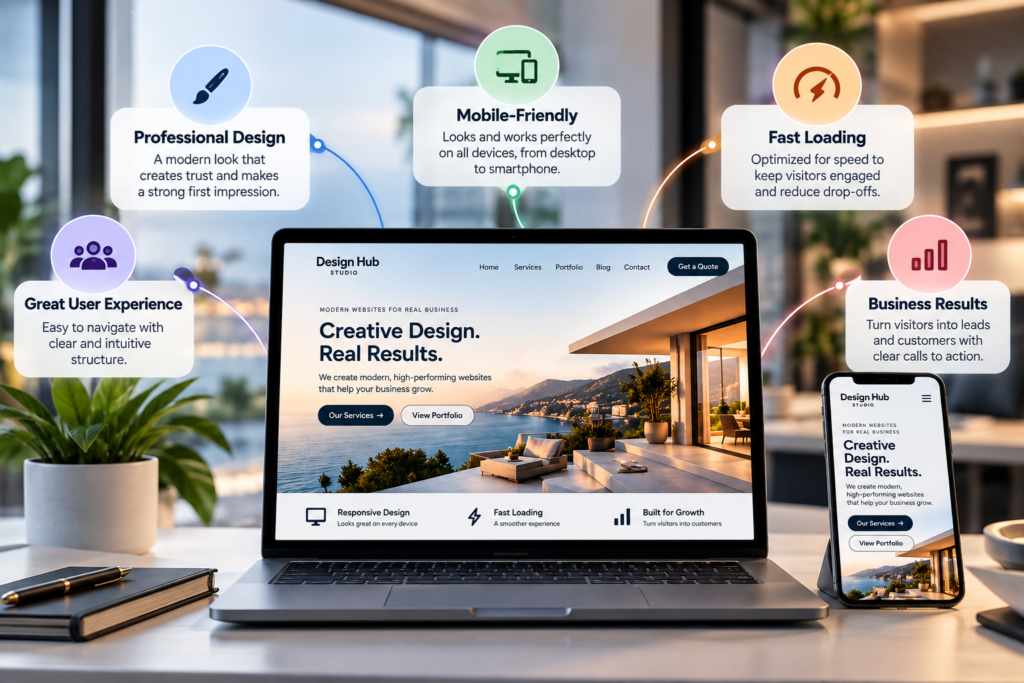
Visual design that creates a strong first impression.
User experience that makes navigation intuitive.
Responsive design that works across devices.
Performance optimization that keeps the experience fast and smooth.
Content strategy that communicates the value of the business.
Clear calls to action that guide visitors toward the next step.
When these elements work together, the result is more than an attractive webpage.
It becomes a digital experience designed around real people and real business objectives.
Final Thoughts
A website doesn’t need to be overloaded with animations, complicated layouts, or the latest visual trends to be effective.
Sometimes the strongest design is the one that makes everything feel simple.
Visitors can immediately understand the business. They can find the information they need. The website works properly on their phone. Pages load quickly. The branding feels consistent. And when they’re ready to take action, they know exactly where to go.
Good website design isn’t simply about making a website look good. It’s about making the website work well—for the people who use it and for the business behind it.
At Design Hub Studio, we believe effective web design should bring creativity, usability, performance, and business strategy together to create a digital presence that is not only visually appealing, but built to perform.